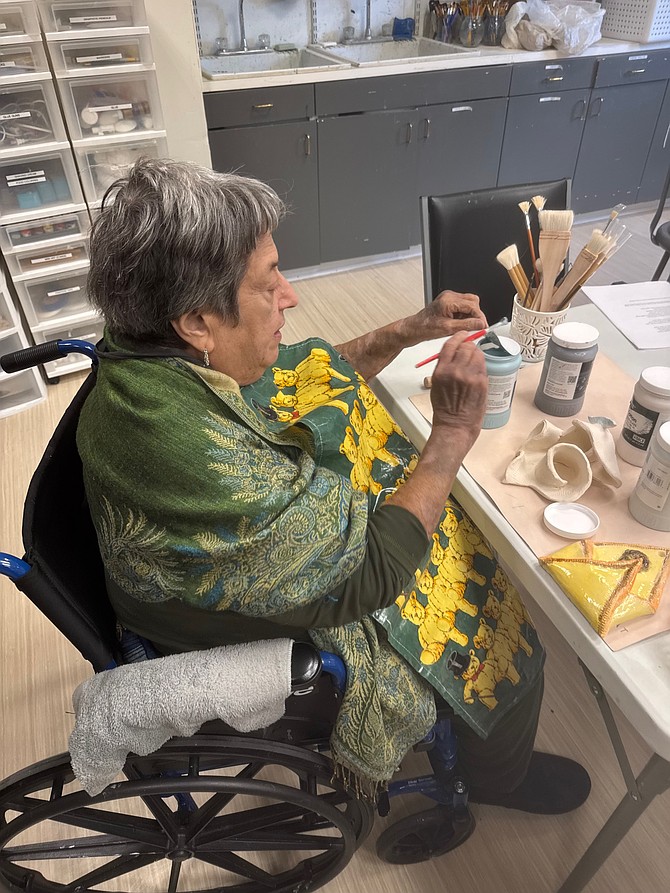
Bryna Freyer, a retired art historian, paints a delicate blue rim on a clay vessel during a studio session at The Jefferson.
Carefully and almost meditatively, Bryna Freyer steadies a small clay vessel in one hand and lifts a brush with the other, guiding a thin line of pale blue paint around the rim.
The retired art historian and current resident at The Jefferson, a senior living community, pauses occasionally to study the curve before adding another careful stroke. Nearby, jars of gray, teal, and cream pigments sit open on the table.
“Working with clay in particular is very relaxing,” she says. Then she smiles. “With ceramics, I don’t obsess about whether mine is good enough anymore. I’m just enjoying it.”
Freyer spent much of her career studying museum collections and teaching art history. For years she analyzed great works created by other artists.
Now she is making something of her own.
Around her, residents at The Jefferson gather for a studio session, some sketching still lifes, others mixing watercolor pigments or shaping clay. The walls display landscapes, flowers and abstract bursts of color, each piece created by someone who lives in the community.
For many residents, creativity here is more than a pastime. It’s a way to slow down, concentrate, and lose themselves in the process of making something.
The Quiet Power of Creativity
Wendy Kotler understands that feeling well.
A retired art educator, she worked for public school systems as both a teacher and developer of art curriculum. Kotler still approaches art with the careful eye of someone who spent a career helping students learn to notice the small details all around them, the curve of a leaf, the shift of light across a surface, the subtle changes of color in the sky.
When she paints, she often leans close to the canvas, studying the way light settles on a petal or the subtle shift between shades of purple.
For Kotler, painting often begins with something that others might overlook. One of her recent paintings was inspired by orange lilies in a bouquet on a table in the home of her sister-in-law.
“When I’m drawing,” she explains, “I’m intensely focused on the connection between my eye and the subject. Everything else drops away.”
In that moment, the outside world recedes, and worries fade.
“If you’re anxious or agitated,” she says, “once you move into that creative space, it goes away.”
Researchers agree. Studies supported by the National Endowment for the Arts suggest that artistic engagement can support cognitive health while reducing depression and anxiety, particularly among older adults.
Kotler traces her own artistic path back to kindergarten.
“We were supposed to draw a person,” she recalls. “My teacher leaned over and said, ‘Your person has a hand with five fingers. You’re really good at this.’”
Encouragement like that, she believes, can shape a life.
“If you talk to people in creative fields,” she says, “somewhere along the line someone noticed something and reinforced it.”
Creativity Beyond the Studio
At The Jefferson, creativity extends well beyond the art room.
Lynn Barton, chair of the community’s garden club, first discovered her love of gardening as a child helping her grandmother in the yard.
Her favorite job was pulling weeds.
“I liked getting rid of the bad things so the good things could grow,” Barton says.
Today she helps coordinate plantings around the Jefferson grounds, where residents gather to dig, water, and plan new additions each season.
“A neighbor once told me the garden is always a work in progress,” Barton says. “And that’s true.”
At The Jefferson, creativity is also woven into daily programming.
Dawn Hamed, activities coordinator for assisted living and memory care, says the key is understanding what residents care about.
“It all starts with building relationships,” Hamed says. “We learn what people loved doing before they came here and build activities around those interests.”
Sometimes the impact is immediate. Hamed remembers one resident who initially refused to leave his room or attend any activities.
Now he rarely misses one.
“He may not follow the instructor exactly,” she says. “But he’s there doing his own thing. And just being there means he’s engaged.”
The power of creativity to affect one’s mental and emotional wellbeing at any age, appears on studio walls, in garden beds and in the satisfaction of making something by hand.
As Kotler puts it simply: “It’s never too late.”