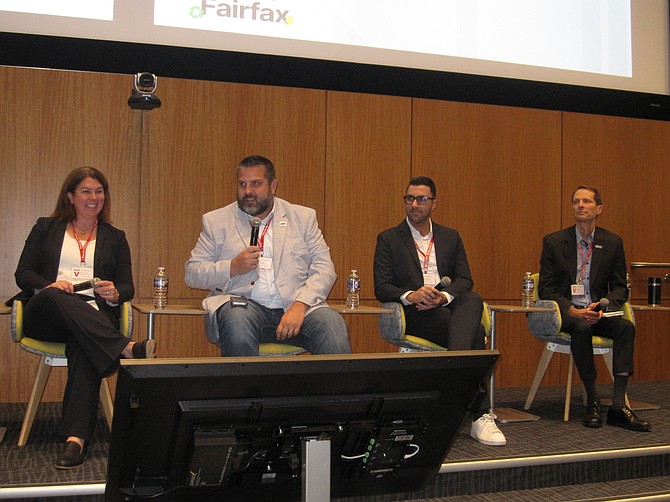
Opening the Oct. 19 Green Fairfax Environmental Summit, Dalia Palchik, Providence District member of the Fairfax County Board of Supervisors, teed up some of the challenges of an urbanizing county, asking, “Can the county grow and be more sustainable at the same time?”
Noting that 30 years ago people could get to Tyson’s Corner only by car, today there are four Metro subway stations. “We must transform an environment built for the car,” she emphasized, adding, “I’m working to transform Tysons.”
Since there is little land left to develop, “It’s all about redevelopment,” she said. “When we build up instead of out, we protect the green space we'd otherwise pave over. A new building can use a fraction of the energy of the office park it replaces. A redevelopment can add the stormwater management and tree canopy that an old parking lot never had. Every new project is a chance to fix something that we weren't thinking about 30 to 40 years ago."
Around 100 people from the private sector, local governments and non-governmental organizations met at McLean’s Mitre Corporation to explore the county’s infrastructure, environmental conditions and challenges. Palchik hopes this will be the first of future annual summits.
Reusing, Redoing Buildings
Keynoter Tony Malkin stressed that “adaptive reuse” is more environmentally sound than building a new building. “The greenest building is the one already built,” he said, describing how his company revamped New York City’s 95-year-old, 2.8 million-square-foot Empire State Building and cut energy use by 38 percent. He cited the Retrofit Playbook which suggests best practices to address climate change, practices that the playbook says, “create asset value, reduce emissions and enhance the resilience of assets.” Malkin is the chief executive officer of Empire State Realty Trust.
Global Warming Is Here
Climate change is bringing more flooding and more severe and more frequent storms, experts contended. “Fairfax County is experiencing warmer, wetter and weirder climatic conditions,” says Fairfax County’s resilience plan.
The climate resilience panel explored global warming’s local impacts. George Mason University professor Dr. Celso Ferreira said that with decades of development we’ve seen a “drastic transformation in the landscape,” that development often overwhelms stormwater infrastructure. Most of the flooding that occurs is outside the floodplain, he stated, and most stormwater controls were designed based on past assumptions, not for today’s or future rainfall events. “We must make room for the water,” he said, “and live with water instead of fighting it. Water will flow, like it or not.”
Eleventh District Congressman James Walkinshaw also pointed out that “weather events are worsening,” and asserted that the federal government is “moving in the wrong direction,” with the Trump administration taking steps like “disinvesting in clean energy” and abandoning the Paris Accords, an international treaty to combat climate change.
Walkinshaw has introduced a bill that addresses federal facilities and “heat island” effects and another requiring the Defense Department to collect extreme weather data. Climate change is a serious threat to the military, he said.
Falls Church Mayor Letty Hardi noted that buildings and transportation account for 90 percent of greenhouse gas emissions and that Falls Church is planting more trees and “growing up” instead of sprawling out.
State Senator Saddam Salim credited Virginia’s 2020 Clean Economy Act with requiring the state’s electricity providers to reduce greenhouse gas emissions by moving to less-polluting energy and setting energy-efficiency standards.
Transportation accounts for 43 percent of greenhouse gas emissions in car-centric Fairfax County. To garner more support for public transit, people must “get comfortable with vehicle congestion,” Maria Lashinger with Gorove Slade remarked, to uncomfortable snickers.
Bill Pugh with the Coalition for Smarter Growth advocated fixing existing roads before building more. Fairfax County’s 2023 “Parking Reimagined” was a “game changer,” he said. This zoning change was intended in part to address excess parking and improve walkability and biking infrastructure.
One panel offered ways to design landscapes and “give nature a voice,” as Dr. Sharon Bradley put it. Bradley is with Bradley Site Design.
Torsha Bhattacharya with the Fairfax County Park Authority called parks “multi-vitamins” that can address climate change and boost peoples’ physical and mental well-being.
Growing and being sustainable can go hand in hand, most speakers maintained.